
If you are researching the NHTD or TBI waiver program, chances are you or someone you love is facing a difficult moment: a hospital discharge that feels rushed, a nursing home placement that does not feel right, or a brain injury that has changed what daily life looks like. It is a lot to take in, and the last thing any family needs is a confusing maze of program names and Medicaid terminology standing between them and the right care.
This guide is here to make that maze a little clearer. New York State’s Nursing Home Transition and Diversion (NHTD) and Traumatic Brain Injury (TBI) both exist for a simple, human reason: to help people live in their own homes and communities, surrounded by the people and routines they love, instead of in an institution. Below, we walk through what each program covers, who qualifies, how the enrollment process actually works, and how to choose a provider you can trust with something this important.
What is the NHTD waiver program?
The Nursing Home Transition and Diversion (NHTD) waiver program is a New York State Medicaid Home and Community Based Services (HCBS) waiver. It was created under Section 1915(c) of the federal Social Security Act, which allows states to use Medicaid funding for community based care instead of institutional care, as long as the cost stays comparable to nursing facility care.
In everyday terms, NHTD gives New Yorkers who would otherwise qualify for nursing home placement a real, funded alternative: staying in their own home, an apartment, or a family member’s residence, with services built around their specific needs.
The program supports two groups of people:
- Those currently living in a nursing facility who want to transition back into the community
- Those living in the community who are at risk of nursing facility placement and need services to remain safely at home
What is the TBI waiver program?
The Traumatic Brain Injury (TBI) waiver program is a companion Medicaid HCBS waiver, built specifically for individuals who have sustained a traumatic brain injury and need specialized, community based support to live independently. Brain injury recovery often touches cognition, communication, mobility, and behavior in ways that general home care was never designed to address. The TBI Waiver exists to close that gap, offering services that are tailored to brain injury recovery and long term community life, not just physical assistance.
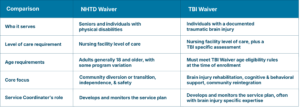
While NHTD and TBI share a similar overall structure, TBI has its own eligibility rules, its own service coordination process, and its own network of specially trained providers, reflecting the more specialized nature of brain injury care.
NHTD vs. TBI Waiver: Key differences at a glance
Learn more about how Always Compassionate Health supports individuals and families navigating New York’s NHTD and TBI Waiver Programs.
Explore NHTD & TBI Services
Who qualifies for NHTD or TBI waiver services?
Eligibility for both programs is determined by New York State, not by individual home care agencies. Generally, applicants need to:
- Be enrolled in New York State Medicaid, or be in the process of Medicaid enrollment as part of the waiver application
- Meet a nursing facility level of care, as determined through a state administered clinical assessment
- Choose community based living over nursing facility placement, since both programs are built around informed personal choice
- For the TBI Waiver specifically, have a documented traumatic brain injury and meet the program’s age eligibility requirements at enrollment
Meeting these baseline requirements is an important first step, but it is not the same as automatic enrollment. Both programs follow a structured application and assessment process, guided by a Regional Resource Development Center (RRDC) and a dedicated Service Coordinator who will walk alongside you through each stage.
How the Application and Enrollment Process Works
Applying for the NHTD or TBI waiver program can feel overwhelming at first, especially when families are already managing a hospital discharge, a new diagnosis, or changes in a loved one’s care needs. While the process includes several required steps, families do not have to navigate it alone.
Here is what the application and enrollment process generally looks like:
- Initial referral. The process can be started by the individual, a family member, a hospital discharge planner, or nursing facility staff.
- Regional Resource Development Center review. The Regional Resource Development Center, or RRDC, reviews the referral and helps connect the individual and their family with a Service Coordinator.
- Level of care and eligibility assessment. A clinical assessment is completed to determine whether the individual meets the nursing facility level of care requirement, along with any other program-specific eligibility criteria.
- Service Plan development. Once eligibility is confirmed, the Service Coordinator works closely with the participant and their family to create an Initial Service Plan. This person-centered plan outlines the participant’s goals, the services they need, and the approved providers who may support them.
- Choosing a provider. Participants have the opportunity to select approved providers for each service included in their plan. This is often when families choose a home care agency, such as Always Compassionate Health.
- Ongoing reassessment. Service Plans are reviewed over time to make sure care continues to reflect the participant’s needs, goals, and changing circumstances.
Since the process involves several state and regional steps, timelines can vary from one family to another. Enrollment may take several weeks or, in some cases, a few months. Starting the conversation with a Service Coordinator as early as possible, especially during hospital discharge planning, can help families feel more prepared and reduce avoidable delays.
What services are covered under NHTD and TBI waivers?

Both waiver programs fund a range of home and community based services designed to replace what a nursing facility would otherwise provide, while allowing participants to stay in the home they know. Commonly covered services include:
- Home and Community Support Services (HCSS) Support with personal care, household tasks, mobility assistance, and daily activities that make safe, independent living at home possible.
- Personal Care Assistance Help with bathing, dressing, grooming, meal preparation, and other daily routines that support comfort, hygiene, and dignity.
- Independent Living Skills Training (ILST) Hands on coaching in budgeting, meal preparation, transportation, communication, organization, and self advocacy. These are skills that build lasting independence, not just temporary help.
- Respite Services Temporary relief for family caregivers, so they can rest and recharge while their loved one continues to receive consistent, quality care.
- Community Integration Support Help accessing community resources, social opportunities, educational programs, and recreational activities that keep participants connected to the world around them.
- Medication Reminders and Wellness Monitoring Support with medication adherence and gentle observation of any health changes that might need a doctor’s attention.
- Assistance with Activities of Daily Living (ADLs) Support with mobility, transfers, and other physical needs that help participants stay independent and safe day to day.
- Care Coordination Support Ongoing collaboration between the home care provider, the Service Coordinator, physicians, therapists, and family members, so the service plan continues to reflect the participant’s evolving goals.
Not every participant receives every service listed here. The right mix is shaped by each person’s individual needs and the goals laid out in their Service Plan.
The role of the service coordinator
The Service Coordinator is there to help guide participants and their families throughout their time in the NHTD or TBI Waiver Program. They serve as a consistent point of contact, helping families understand the process, stay informed, and feel supported along the way.
Their responsibilities generally include:
- Guiding the individual and family through the eligibility and enrollment process
- Developing and updating the Initial Service Plan and any Service Plans that follow
- Connecting participants with approved providers for each authorized service
- Checking in to make sure services are meeting the participant’s needs
- Helping address questions or concerns as they arise
- Coordinating communication between the participant, their care providers, and New York State
Families should feel comfortable staying in regular contact with their Service Coordinator. As needs change, they can ask questions, raise concerns, or request updates to the Service Plan so care continues to reflect the participant’s goals and daily life.
Have questions about the waiver process or where to begin? Our team can help you better understand your next steps.
Talk to Our Team
Choosing a home care provider for NHTD or TBI waiver services
Once a Service Plan is approved, participants have the right to choose their own provider for each type of service. When you are weighing your options, a few things are worth considering:
- Experience with the specific waiver. NHTD and TBI each have their own documentation, billing, and service delivery requirements, so experience with your particular program matters.
- Existing relationships with Service Coordinators and RRDCs. Providers who already have strong working relationships in place tend to make onboarding smoother and faster.
- Range of services offered. A provider who can offer several waiver eligible services, like personal care, HCSS, respite, and community integration, can mean fewer separate agencies for your family to coordinate with.
- Communication and reporting. Look for a provider who reaches out proactively to keep you and your Service Coordinator informed, rather than waiting to be asked.
- Caregiver training and consistency. This matters for anyone, but it is especially important for TBI participants, where familiar caregivers who understand cognitive and behavioral needs can make a real difference in day to day quality of life.
Always Compassionate Health is an approved NHTD and TBI Waiver provider serving participants throughout New York State. We offer personal care, HCSS, respite, community integration support, and care coordination as part of one connected, person centered care team.
Getting started
For families navigating a nursing facility stay, a recent hospitalization, or a new brain injury diagnosis, the NHTD and TBI Waiver Programs offer a real, Medicaid funded path back to independent, community based living. That path works best when it starts early and when it is guided by people who genuinely understand the process.
If you or a loved one is enrolled in, or exploring eligibility for, the NHTD or TBI Waiver Program, the team at Always Compassionate Health is here to help you understand your options and connect with the right Service Coordinator to get started.
Whether you are beginning the eligibility process or already have an approved Service Plan, our team is here to help.
Get Started Today
View NHTD & TBI Services
This guide is intended for general informational purposes and reflects New York State NHTD and TBI Waiver Program structures as generally administered. Program rules and eligibility criteria are determined by New York State and may be updated over time. Individuals should confirm current requirements with their Regional Resource Development Center or Service Coordinator.
Frequently Asked Questions
The NHTD Waiver serves eligible seniors and individuals with physical disabilities who want to remain in or return to community living. The TBI Waiver is specifically for individuals who have sustained a traumatic brain injury and need specialized services that address cognition, communication, mobility, and community reintegration.
Yes. Both programs are Medicaid Home and Community Based Services (HCBS) waivers, which means services are specifically designed to be delivered in a participant’s own home or community setting rather than in a nursing facility.
Eligibility is determined by New York State based on Medicaid enrollment status, a nursing facility level of care assessment, and, for TBI applicants, documentation of a traumatic brain injury along with age eligibility requirements. A Service Coordinator or Regional Resource Development Center can help you formally assess eligibility.
Timelines vary by region and individual circumstances, but the full process, from referral through level of care assessment to an approved Service Plan, commonly takes several weeks to a few months. Starting the referral process early, particularly during hospital discharge planning, can help avoid unnecessary delays.
No single person has to make the referral alone. Individuals, family members, hospital discharge planners, and nursing facility staff can all start the referral process, which is then routed to the Regional Resource Development Center serving your area.
Yes. Once a Service Plan is approved, participants choose approved providers for each authorized service category, which means your family has real input into who provides care.
Yes. We work closely with Service Coordinators, healthcare professionals, participants, and families to make sure services stay aligned with each individual’s approved Service Plan and personal goals.
Service Plans are reviewed and updated over time. Participants or their Service Coordinator can request a reassessment whenever care needs increase, decrease, or simply change.