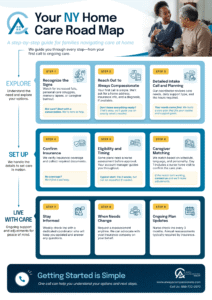

A step-by-step guide for families who need support at home
Overview
Finding home care in New York state can feel complicated, especially if you are arranging services for the first time. Between insurance requirements, documentation, eligibility steps, and coordinating a start date, it is easy to feel unsure about what to do next.
This roadmap explains the home care process in a clear, practical way so you understand what to expect, what information is typically needed, and how the timeline usually unfolds. It also outlines how Always Compassionate Health supports you at each stage, from your first call through the start of care and beyond.
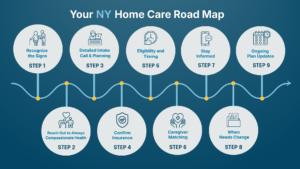
Always Compassionate’s Promise to Families
You should not have to navigate home care alone. When you reach out, we guide you through the process from start to finish. We help you understand what your next step is, what information is needed, and how to move forward as smoothly as possible.
Step 1: Recognizing When It May Be Time for Home Care
Many families begin looking into home care when they notice a meaningful change in a loved one’s ability to live safely at home. These changes are not always sudden. In many cases, they build over time until it becomes clear that extra support is needed to maintain health, safety, and stability.
Home care may be worth exploring if you are noticing concerns such as:
- Safety risks at home: increased falls, unsteady walking, leaving the stove on, or difficulty moving safely around the home.
- Difficulty keeping up with personal care: trouble bathing, getting dressed, using the bathroom safely, or managing basic hygiene consistently.
- Changes after a health event: a recent hospitalization, surgery, or illness that makes it harder to recover independently at home.
- Memory or confusion concerns: increasing forgetfulness, disorientation, or difficulty following routines that used to be manageable.
- Caregiver strain: you are providing more support than before, and it is becoming difficult to balance caregiving with work, family responsibilities, or your own health.
If any of these situations sound familiar, the next step does not have to be a major decision. It can start with a conversation. Speaking with our team can help you understand whether home care is appropriate, what options may be available, and what the next steps typically look like.
For additional guidance as you are getting started, you can review our FAQ page.
Step 2: Reaching Out to Always Compassionate
Your first call is designed to be simple and helpful. We will ask a few basic questions so we can understand your situation and explain what happens next.
During this first conversation, we typically ask for:
- Your loved one’s home address
- Diagnosis information from the primary care provider (PCP), when needed
- Basic demographic information
- Insurance information
- A copy of the insurance card
- Any additional documentation your insurance requires
- In some cases, proof of residence (such as a lease) may be requested
If you do not have every document available, that is okay. Requirements can vary, and we will guide you on what is needed based on your situation.
Step 3: Completing a Detailed Intake Call and Planning for Care
Once you are ready to move forward, an intake coordinator will complete a detailed care assessment and planning call. This step helps us gather the information needed to plan services that align with your loved one’s needs and daily routine.
During this call, we review:
- Your loved one’s needs and diagnosis
- Preferences for the caregiver
- The type of support you are looking for
- How many hours may be needed
- What time of day support is needed
You can also share practical examples of what support would make daily life safer and easier.
Common examples include:
- Laundry support, such as washing, folding, and putting clothing away
- Grocery shopping support for essential food and household items
- Support with walks, including accompaniment for safety and mobility support
Step 4: Confirming Insurance and Required Information
Once we understand the type of care you are seeking, we help confirm what coverage is in place and what requirements must be completed to begin services.
Two common questions families ask are:
- Does my insurance cover long-term care?
- Can you check if I have Medicaid?
To move the process forward, we may ask for:
- A copy of the insurance card
- Demographic information
- Diagnosis information from the primary care provider (PCP), when required
- Additional documentation depending on insurance requirements
- In some cases, proof of residence such as a lease
If your insurance does not cover long-term care, we still support you. We guide you through the steps involved and help you work toward the appropriate pathway for long-term care services.
For more information: Paying for Care
Step 5: Eligibility, Assessments, and Timing
The timeline to start home care depends on eligibility and the approval steps required by insurance. In many cases, if a client is already eligible, care can begin in about 1 to 2 weeks, and sometimes sooner.
At this stage, the focus is on confirming what services can be approved and how many hours of care can be authorized. Insurance decisions are generally based on documented need, which is why some plans require an in-home assessment before approving hours. During an in-home assessment, a nurse visits the home to better understand the client’s day-to-day needs and level of support. This information helps the insurance plan determine the appropriate number of hours and the schedule for care.
While insurance reviews and assessments are in progress, your account manager at Always Compassionate helps keep things clear and organized. We confirm what documents are still needed, help you understand what the insurance plan is requesting, and stay in contact with you as updates come in. Once the insurance plan issues authorization, we can move forward with scheduling and begin services.
Step 6: Caregiver Matching and Starting Care
Once insurance is approved, we shift from the approval process to what families care about most: who will be coming into the home and what the first days of care will look like. Our goal is to start services in a way that feels organized, respectful, and supportive for the client and family.
How we match your loved one with the right caregiver
We match caregivers based on the care plan and the preferences shared during the care planning conversation. Matching is intended to support comfort, consistency, and communication in the home.
Matching factors may include:
- Schedule needs: the times of day care is needed
- Language preferences: when language compatibility supports clearer communication
- Personality and communication style: for example, whether the client prefers a calm, quiet presence or a more conversational approach
- Home environment: Including whether there are pets in the home and whether the caregiver is comfortable in a pet-friendly setting
Understanding PCA and HHA caregivers
Our caregivers are trained and certified in New York as either a Personal Care Aide (PCA) or a Home Health Aide (HHA).
A PCA provides support with daily routines and basic household tasks that help a client remain safe and comfortable at home.
An HHA supports daily routines and also assists with medical-related tasks and managing health conditions, as outlined in the plan of care.
To learn more, check out our page: Home Health Aide and Live-In Caregivers
What to expect in the first few days
The first few visits focus on helping everyone settle into a steady routine.
Day one: nurse visit and assessment
A nurse comes to the home on day one to assess the client and confirm the plan of care.
Caregiver readiness
Before a caregiver is scheduled, they complete an orientation process and a nurse-led competency review to support safe, appropriate care.
Establishing the routine
During the first few visits, the caregiver becomes familiar with the client’s routine, the home environment, and household preferences. Families can support a smoother start by sharing practical information such as routines, mobility or safety considerations, communication preferences, and pet-related notes.
Adjustments if needed
If the caregiver match is not working once care begins, you can contact your designated point of contact. We will work with you to make changes as appropriate.
Step 7: Staying Informed Once Care Begins
Once home care starts, most families have two priorities: knowing that care is going well, and knowing who to contact if something changes. Clear communication helps prevent confusion, supports consistency, and makes it easier to adjust care when needed.
It is also common for needs to shift over time. This can happen for practical reasons, such as a change in routine, a change in mobility or safety needs, recovery after a health event, or realizing that certain times of day require more support than originally expected. That is why ongoing check-ins and open communication are an important part of care.
What you can expect:
- A clear point of contact
You will have a designated point of contact who can answer questions, share updates, and help address concerns. - Visibility into who is providing care
We communicate key details such as who is coming into the home, including the caregiver’s name and the nurse’s name. - Regular check-ins
After intake, the case transitions to coordination. In the first week, you can expect outreach from the staffing coordinator who serves as the point person. From there, staffing coordinators continue regular check-ins, including weekly updates.
Communication preferences are documented
We document preferred contacts in our system, including emergency contacts and who should receive updates. If requested, communication can be directed only to the designated healthcare proxy.
Family Portal (coming soon)
We are also preparing to launch our Family Portal, which will provide families with easier access to information in one place. This platform is not fully available yet, but it is coming soon.
Step 8: When Needs Change and Additional Hours Are Needed
Care needs often change over time. Sometimes the change is gradual, and sometimes it becomes clearer once care begins and your loved one’s day-to-day routine is better understood. You may find your loved one needs support at different times of day, needs help with additional tasks, or requires more hours to remain safe at home.
If you believe more hours are needed than what is currently approved, you can contact us at any time. We can speak with the insurance company on your loved one’s behalf and request a reassessment, which is typically required before additional hours can be authorized.
It is important to know that securing additional hours can be challenging. If hours are denied or need to be reconsidered, we may also connect clients with elder law attorney partners who can help guide the appeals process.
Step 9: Reassessments and Ongoing Care Plan Updates
Reassessment timing depends on insurance. Many clients are approved for long-term care for one year, with a reassessment completed after that period. Our team also sends a nurse every three months to check in and update the plan of care if needed.
Families can share what they would like to add or remove from the plan of care at any time, and the nurse can update it accordingly.
Getting Started
If you are considering home care for a loved one, starting with a conversation can make the process feel much more manageable. Our team can help you understand your options, complete the intake process, confirm coverage requirements, and coordinate the steps needed to begin services. Once care begins, we stay connected through consistent check-ins and ongoing support as needs change.
Ready to get started? Contact us here